

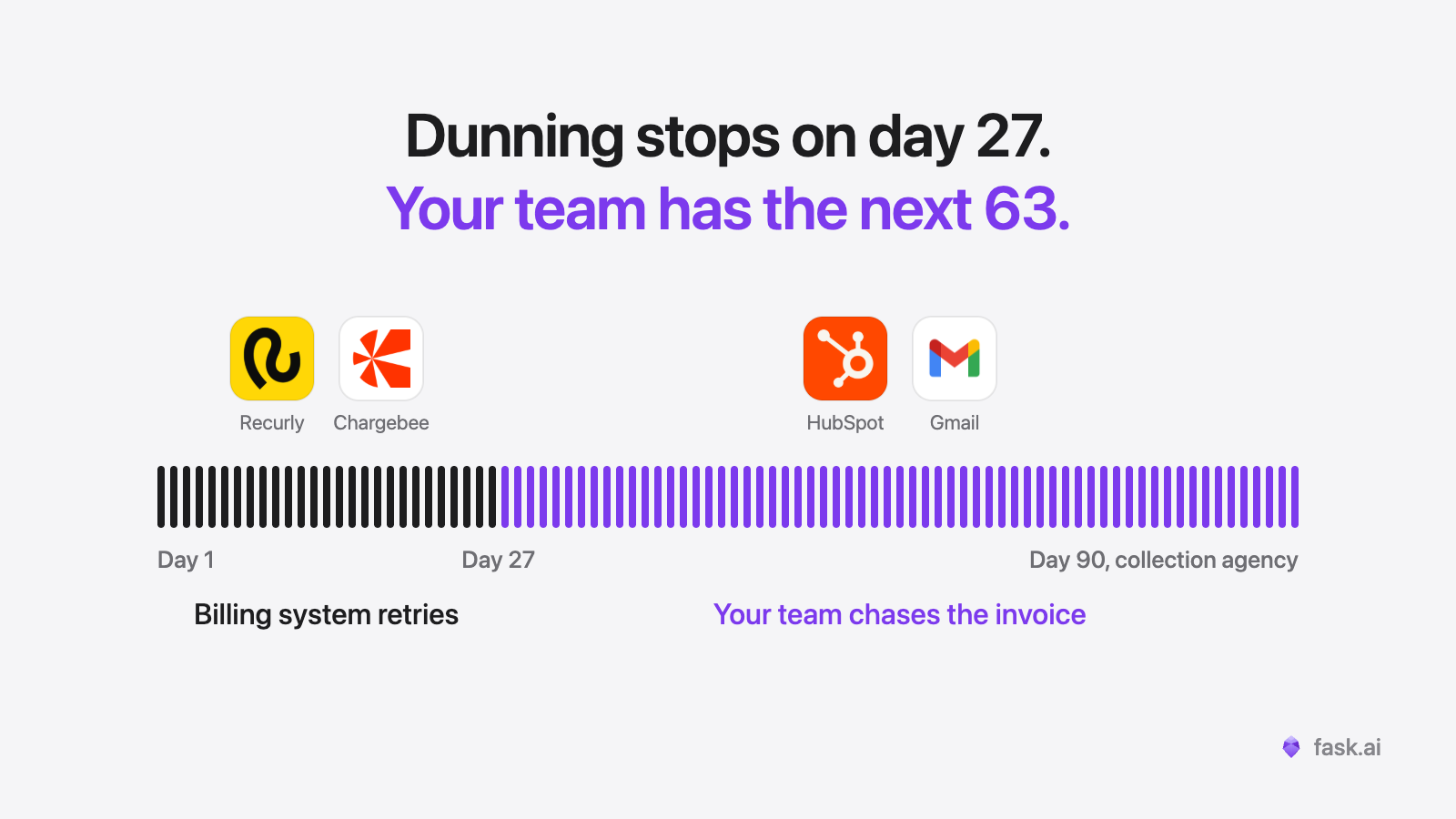
Most guides stop where dunning stops. The work that comes next has four steps.
- Check what your billing system does with the invoice.
- Build one past-due list each morning.
- Follow up on a schedule, and log every call and email.
- Hand off to a collection agency on a set day.
What happens to an invoice when dunning ends
That depends on a setting, and the default may surprise you.
- Recurly. By default it marks the invoice failed and writes it off as bad debt, which takes the balance off the customer's account. You can set it to leave the invoice past due. Whether the subscription also ends is a separate setting.
- Chargebee. You pick the final action. The choices include marking the invoice not paid, voiding it, which cancels it, or writing it off. The subscription can stay active or end.
If you mean to keep collecting, do not let the billing system void the invoice or write it off. In Recurly you can still mark a past-due invoice paid when the money arrives another way, such as a check or a wire.
Build one past-due list each morning
Pull every unpaid invoice past its due date, whatever status it shows. Include any the billing system wrote off. For each one you need the invoice number, the account, the amount still unpaid, the days late and the payment status.
Then take off the ones already being paid. An ACH payment is a bank transfer from the customer's bank to yours. Recurly shows the invoice as Processing until the result comes back. Chargebee says payments like ACH usually take five to seven business days to confirm. A reminder sent in those days goes to a customer whose payment is on its way.
Say 42 unpaid invoices are past their due date this morning, and 8 of them have an ACH payment on its way. That leaves 34 to chase.
The billing system is still emailing some of them. Before you write to the rest, look where your team keeps its notes. That is usually the mailbox or a CRM such as HubSpot, the tool that holds your customer records. If the customer has said the invoice is wrong, or promised a date, a reminder is the wrong message.
A follow-up schedule for past-due invoices
Treat this as a start. The days for the call, the letter and the collection agency come from QuickBooks' guide to collections. The call can come while the billing system is still retrying.
| Days past due | What happens | Who does it |
|---|---|---|
| Up to 27 | Retries and reminder emails. Recurly suggests 27 days for monthly plans | Billing system |
| 15 | A phone call | Your team |
| 60 | A formal letter as a final warning | Your team |
| About 90 | Hand off to a collection agency | Your team |
If dunning runs 27 days and the agency gets the invoice at day 90, your team has the 63 days in between.
Put a way to pay in every reminder. Recurly gives each account a page where the customer can enter a new card. Send that link only to the contact on the account. A new card makes Recurly retry the invoices that are still past due, not ones it wrote off.
Write each call and email down where the next person sees it. In HubSpot you can log a call or an email on the customer's record. An email sent from your own mailbox logs itself when you BCC the address HubSpot gives you. HubSpot can also send the follow-up emails itself. A sequence sends timed one-to-one emails from your own mailbox, and needs a Sales or Service seat on a Professional or Enterprise plan. Take the customer out of it when the money arrives.
When to send an invoice to a collection agency
Pick the day in advance. QuickBooks says about 90 days past due. Dun & Bradstreet describes the handoff at 120 days, says agencies are paid only when they collect, and puts the fee at 25% to 45% of the amount owed. At a 30% fee, a $1,000 invoice collected in full pays you $700.
Send the agency the invoice and the record of your calls and emails. When money comes back, record it on the invoice in your billing system. If you skip that, an invoice you left past due keeps showing a balance the customer no longer owes.
Where it still breaks
- Phone calls. Software can show the history. A person still makes the call.
- Money that arrives another way. A check or a wire reaches your bank and nobody marks the invoice paid, so you chase the customer anyway. Check the bank before you chase.
- Notes nobody wrote. A promise made on a call and never logged looks like silence the next morning.
What AI agents do here
A Fask AI agent does the daily part. It builds the list and drafts the reminders that someone would otherwise do by hand each morning. Your team makes the calls and the decisions.
You connect your billing system, your mailbox and your CRM, such as Recurly, Gmail and HubSpot. The agent reads the invoices and leaves out the ones with a payment on its way.
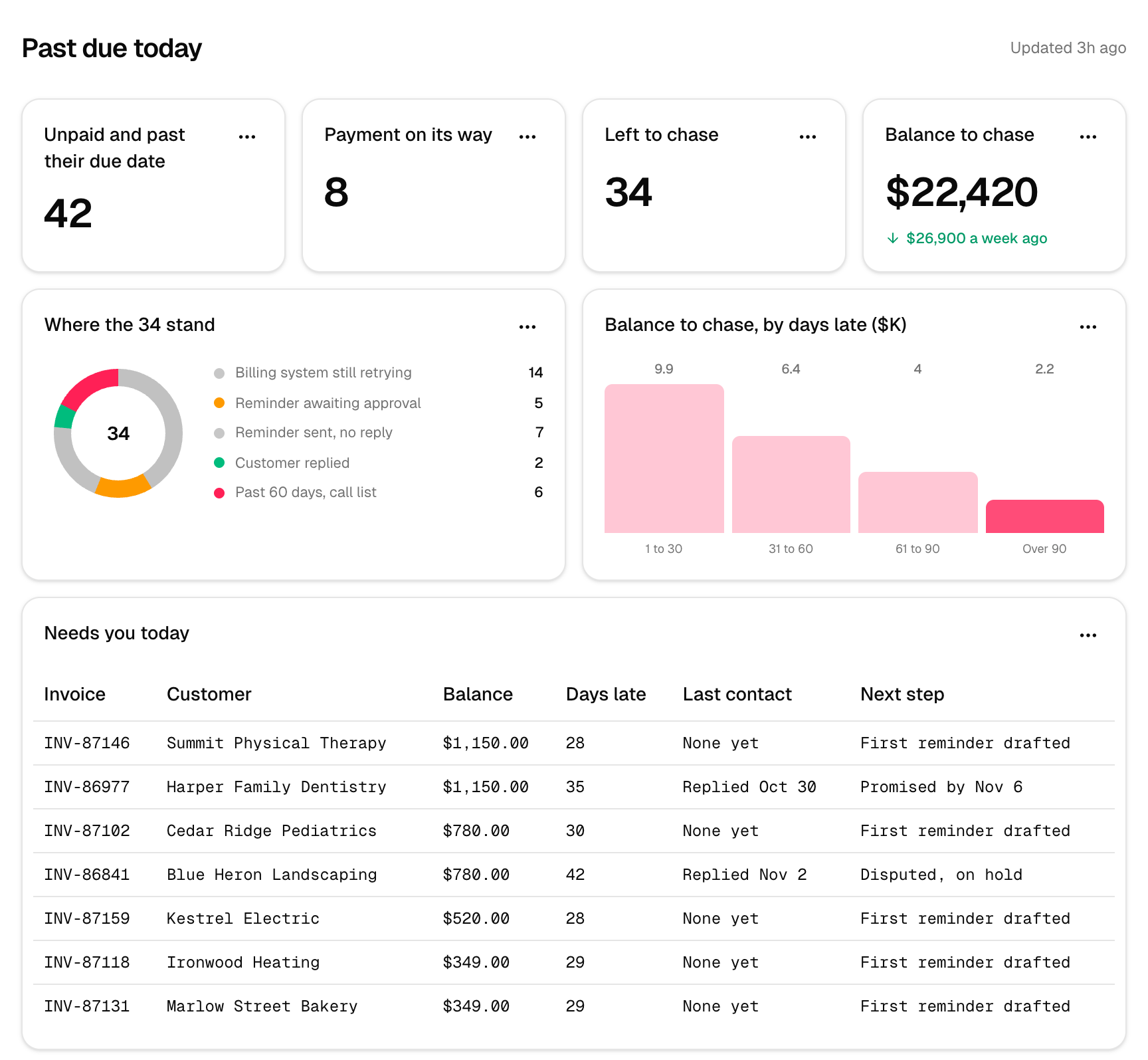
While the billing system is still retrying an invoice, the agent leaves the emails to it. When the retries stop, the agent drafts the reminder, with the invoice number, the balance and the link to update the card. Drafts wait in your team's Fask inbox for approval, unless you tell the agent to send on its own. Approved reminders go out one of two ways. The agent sends its draft from your own Gmail or Outlook and logs it in HubSpot, or it enrols the customer in a HubSpot sequence you have set up, which sends your own template in place of the draft. Both come from your own address, so customers reply to you.
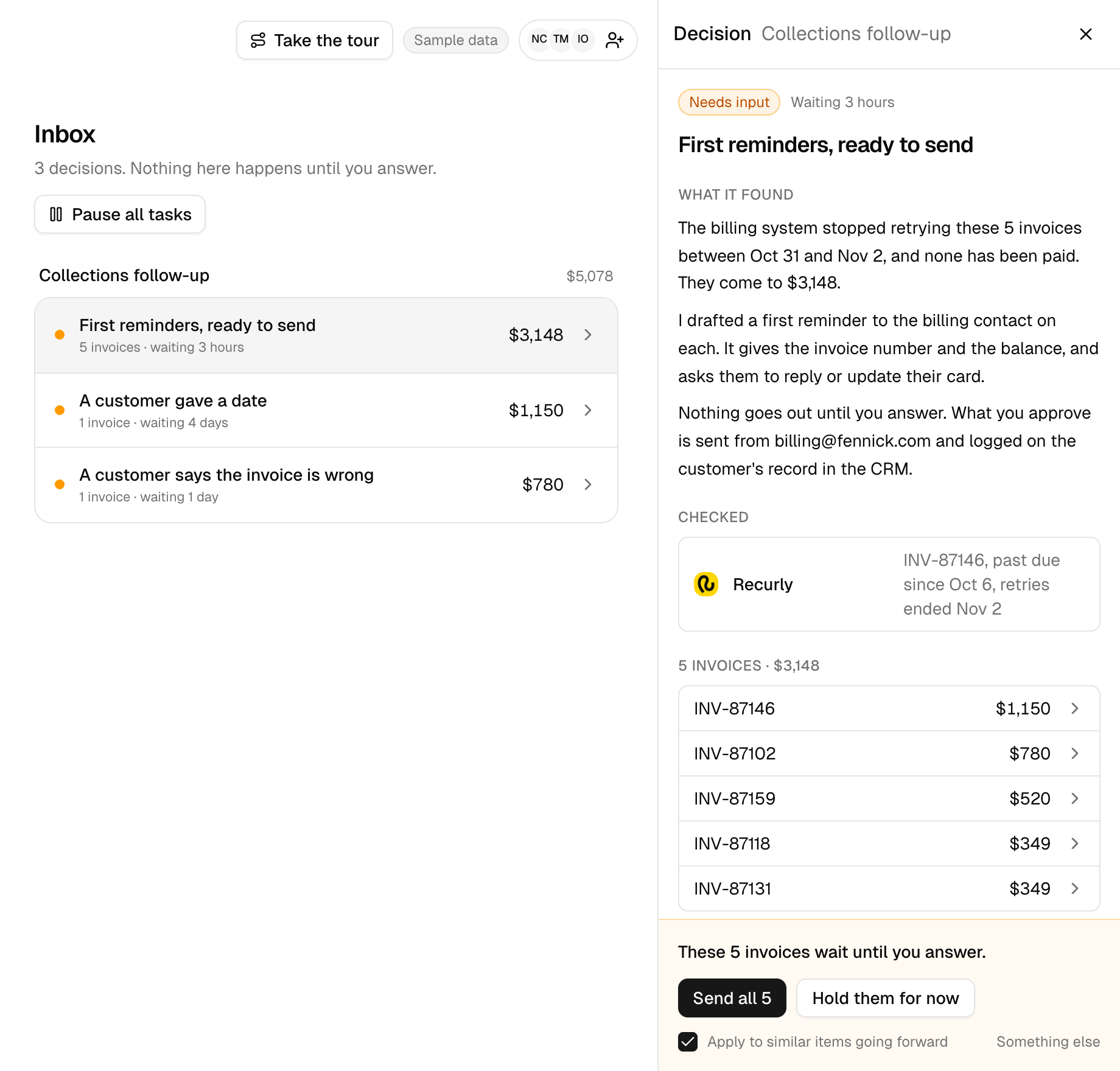
The agent reads the replies too. When a customer gives a date or says the invoice is wrong, it stops the reminders on that invoice and puts the reply in your Fask inbox. It can only read what customers put in writing. When a promise comes in on a call, tell the agent and it stops the reminders.
See customer follow-ups for the rest of what it covers.
Common questions
What is the difference between dunning and collections?
Dunning is the automatic part, where your billing system retries the payment and emails the customer. Collections is the work a person does, such as calls, letters and the handoff to a collection agency.
What happens to a Recurly invoice when dunning ends?
By default Recurly marks it failed and writes it off as bad debt, which takes the balance off the customer's account. You can change the setting so the invoice stays past due.
Should I chase an invoice while an ACH payment is processing?
No. Wait for the result, which can take several business days, and chase only if the payment fails.
When should I send a past-due invoice to a collection agency?
Published guides say about 90 to 120 days past due, after your own calls and a final letter have failed.